
Montessori School
History of School
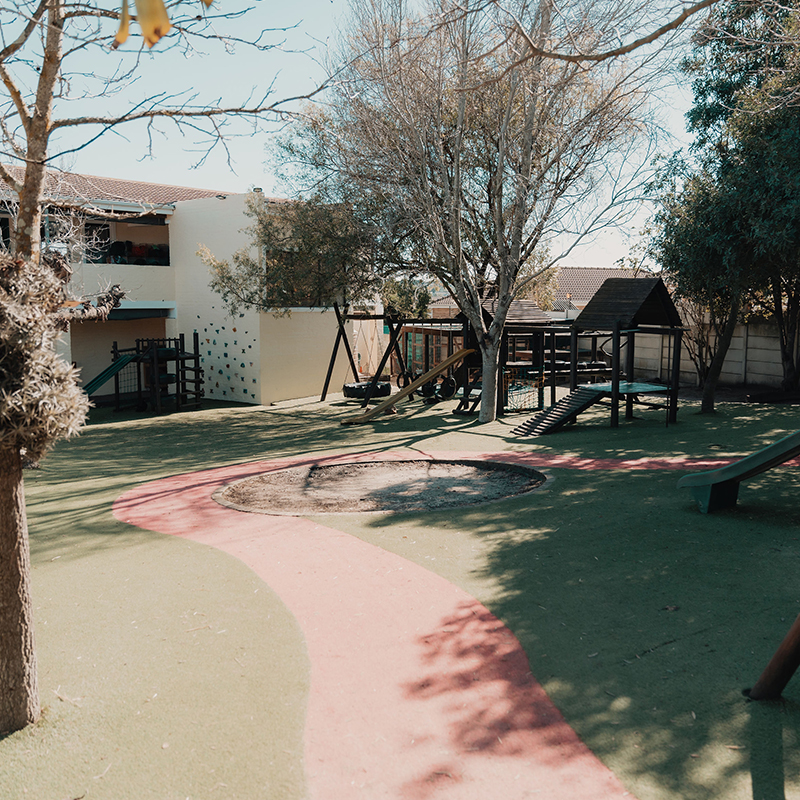
At the beginning of 2000, we started a Bridging Class intending to continue extending the primary school year by year. The number of pupils was growing rapidly so we moved the school, to a school site at ´The Crest´ Durbanville, where we are presently.
At present we can accommodate 145 from the ages of 18 months − 12 years.
Mrs Clark retired in 2023 and the school was taken over by her daughter Holly Williams. The school is run by Holly Williams with Monique Smith as Principal and with the help and assistance of the Parent Teacher Council. The school and the staff are registered with SAMA ( Southern African Montessori Association). All teaching staff are members of SACE (South African Council of Educators).
Rainbow Montessori emphasises hands on, discovery-based learning. Although the program promises to strive for a good standard of excellence, the children are challenged to compete against themselves, rather than each other. At Rainbow Montessori, we also aim for a close partnership between the home and school environment, academic accountability and an innovative program that leads children to develop high levels of personal responsibility, independence and self-confidence.
Maria Montessori always advocated that world peace should be obtained through our children and this we, as a school can start to do with our children by teaching them respect for every other person, religion, colour, nationality or social standing as well as respect for the environment
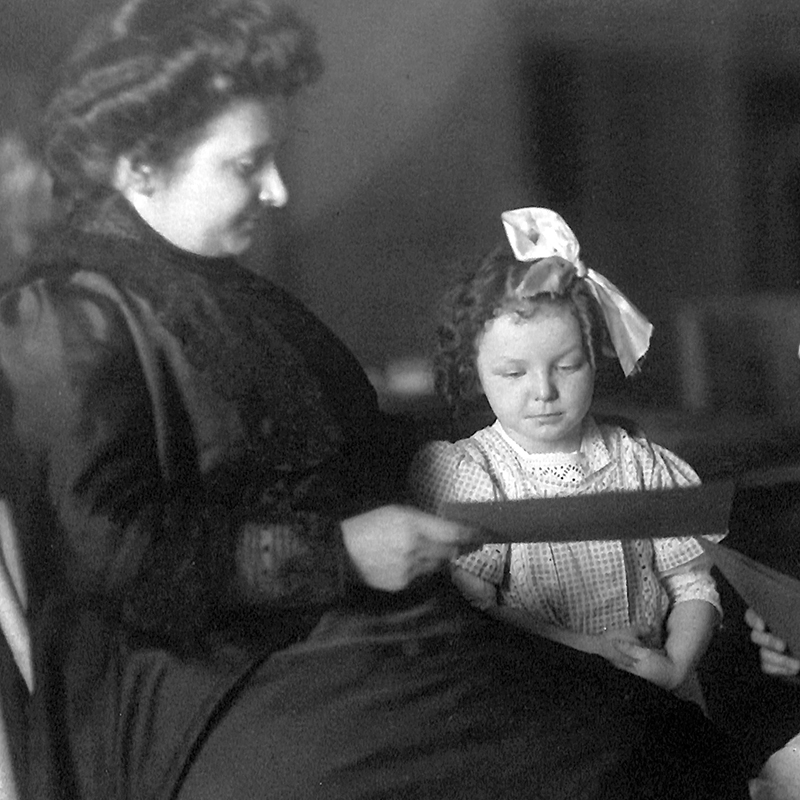
Maria Montessori
As a result of her medical background, she approached education not as an educator or a philosopher, but as a scientist. The Montessori Method of education was developed over many years of observation of children and the development of many ideas and materials that would help them achieve their full potential. Her theories were tailored to the needs of the growing child and sprang from Montessori’s intense love and respect for all children. Her work soon became widely known and she travelled the world, establishing schools and lecturing about her discoveries. She wrote numerous books and many articles until her death in 1952 at the age of 82. She left the world a legacy of a method of education, which combines a practical approach, based on the carefully planned learning environment, with a philosophy centered on the idea of developing independence in the child. She believed all children are intrinsically motivated to learn and that they absorb knowledge without effort, when provided with the right kind of activities, at theright time in their development.
She was nominated for the Nobel Peace prize three times in 1940, 1950, and 1951, with a move a foot again this year (2002) re-nominate her.
Montessori Education
In the Montessori classroom this objective is approached in two ways, by allowing each child to experience the excitement of learning by her own choice rather than being forced. Second, by helping her to reflect all her natural tools for learning, so that her ability will be at maximum in future learning situations. The Montessori materials have this dual long-range purpose in addition to their immediate purpose of giving specific information to the child.
Another observation of Dr Montessori’s that has been reinforced by modern research is the importance of the sensitive periods for the early learning. These are periods of intense fascinations for learning a particular characteristic or skill. Such as going up and down steps, putting things in order, counting or reading. It is easier for the child to learn a particular skill during the corresponding sensitive period than at any other time in her life. The Montessori classroom takes advantage of this fact by allowing the child freedom to select individual activities, which correspond to her own periods of interest.
The Montessori Classroom is indeed a child’s world, geared to the size, the pace and interest of boys and girls. It is designed to put the child at ease by giving his the freedom in a environment prepared with attractive materials. These materials are arranged on low shelves with easy reach of even the smallest child. The tables and chairs in the classroom are moveable, permitting a flexible arrangement for many activities. The children also work on small mats on the floor where they are naturally comfortable. The Montessori materials are divided into three groups:
- The Practical Life Exercises
- The Sensorial Materials
- The Academic Materials
These await each child’s moment of interest in reading, arithmetic and geography. The role of the teacher or Directress is to observe the interests and needs of the child. She demonstrates the correct use of the materials. She is trained to recognise the child’s sensitive periods. She allows the child to discover his own mistakes through further manipulation of the self-correcting materials. She must encourage a child who is hesitant and divert a chid who chooses materials beyond his ability.
The Montessori classroom offers the opportunity from a wide variety of graded materials. Having children ages 18 months through to three years, three to six years, six to nine, nine to twelve years together in a 3 year cycle, permits the younger child a graded series of models for imitation and the older ones an opportunity to reinforce their own knowledge by helping the younger ones.
Montessori at Home
Wouldn’t it be wonderful if the sensitive period for order, which the child experiences, means that he will suddenly keep his room as neat as a pin.
- Take a good look at his room; does he have too many things out at a time? Is your child using everything? For example, keep out one puzzle, one set of stencils and one or two games.
- Does your child have shelves on which to place his toys? While toy boxes encourage confusion and chaos, a simple shelf can encourage a child to take better care of his toys.
- Does your child have suitable containers for toys? Save shoeboxes, ice cream containers – anything sturdy to store cars, blocks, dolls clothes etc.
- Can your child use the bathroom without help? Keep a sturdy stool handy, which the child can use to get to the toilet or reach for his toothbrush. Adjust cupboards so those shelves are low and within his reach. A low mirror will enable him to look at himself and comb his hair. Keep small utensils in the kitchen – like a small pitcher of juice in the fridge and glasses stored low for independent snack.
Remember! Order out of chaos does not come easily, but it does come – if parents act early to help, our children work to the end.

Rainbow Montessori School
The school started in 1995, in the home of Mrs Clark in Kenridge, Durbanville. At the end of the first year there were 10 pupils from the ages of 3 − 6 years. The school was moved to larger premises, a Church building in Eversdal, to accommodate the growing numbers of pupils.



Contact Us
Office Hours
Monday to Friday - 07:30 - 15:00
Tel Number: 021 975 4831
Cell Number: 082 833 2512
Email: info@rainbowmont.co.za
2 Kapokberg Crescent, The Crest, Durbanville, 7551